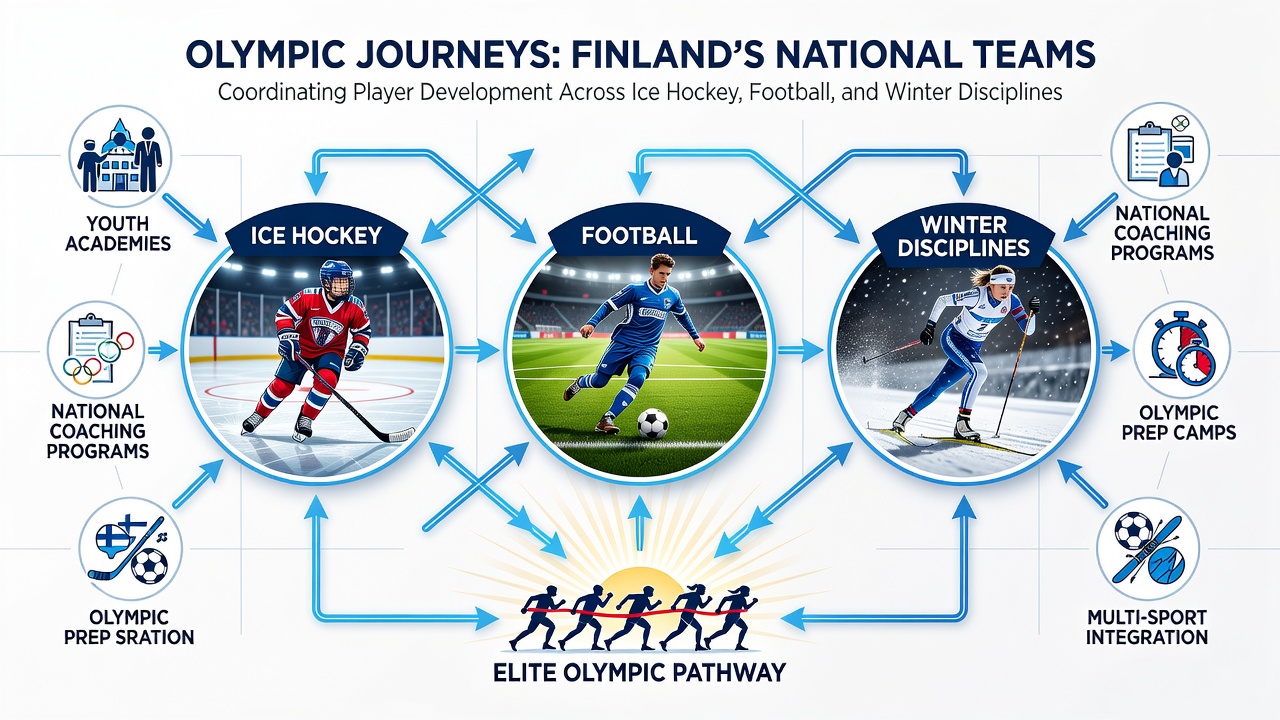
Olympic Journeys: How Finland's National Teams Coordinate Player Development Across Ice Hockey, Football, and Winter Disciplines
Finland maintains structured pathways that link player development across ice hockey, football and winter disciplines through shared resources and oversight by the Finnish Olympic Committee along with individual sport federations. These connections allow talent identification programs to draw from common scouting networks while coaches exchange training methodologies that emphasize endurance, technical skills and recovery protocols suited to Nordic conditions. Data from national performance reports shows consistent athlete progression rates when federations align their junior academies with Olympic qualification timelines rather than operating in isolation.
Integrated Talent Identification Systems
National federations collaborate on early-stage scouting that begins in regional schools and clubs, where physical assessments and skill evaluations feed into centralized databases managed by the Olympic Committee. Ice hockey programs identify players with strong skating fundamentals that transfer effectively to cross-country skiing or biathlon, while football academies highlight athletes whose agility and decision-making under pressure translate well to team-based winter sports like curling. This cross-referencing reduces duplication in testing and helps allocate limited coaching hours across multiple disciplines. Researchers at the University of Jyväskylä have documented how such shared metrics improve retention rates in elite pathways by matching athletes to sports that best fit their physiological profiles.
Training Coordination and Resource Sharing
Joint training camps occur several times each year at facilities in Lapland and the Helsinki region, where athletes from different sports share strength and conditioning staff along with sports science support. Ice hockey players work alongside skiers on balance and core stability drills that prepare both groups for variable ice and snow surfaces, whereas footballers contribute tactical drills that enhance team coordination in relay events or hockey line play. The Finnish Ice Hockey Association and the Football Association of Finland maintain formal agreements that permit equipment and medical personnel exchanges during peak preparation periods. These arrangements prove especially useful ahead of multi-sport Olympic cycles when scheduling conflicts arise between domestic leagues and international competitions.
Pathways Toward 2026 Milestones
Preparations for the 2026 Winter Olympics in Milano Cortina include coordinated qualification events scheduled through the summer and autumn of 2025, with follow-up assessment camps planned for August 2026 that focus on post-Olympic review and next-cycle planning. During these periods federations adjust development plans based on performance data collected from both summer football seasons and winter training blocks. Observers note that this timing allows athletes who compete in multiple disciplines to transition smoothly between Olympic and non-Olympic calendars without losing momentum in their primary sport. External benchmarks from the Canadian Olympic Committee highlight similar multi-sport coordination models that Finland has adapted to local infrastructure constraints.
Case Examples of Cross-Discipline Progression
One documented pathway involves athletes who begin in youth football academies before shifting emphasis toward ice hockey or ski jumping after age 14, when physical growth patterns become clearer. These transitions rely on standardized fitness testing protocols shared across federations, which flag individuals whose speed and power profiles align with demands in winter events. Another example appears in biathlon programs that recruit from ice hockey junior ranks because those players already possess strong shooting accuracy under fatigue. The Olympic Committee tracks such movements through annual progress reports that measure both competitive results and long-term athlete health indicators. Studies published by the European Olympic Committees indicate that nations employing similar cross-sport mobility achieve higher medal conversion rates from identified talents.
Conclusion
Finland's approach to player development across ice hockey, football and winter disciplines rests on deliberate coordination among national bodies that share data, facilities and expertise. This model supports athlete pathways that adapt to individual strengths while aligning with Olympic cycles, including review activities scheduled for August 2026. Continued alignment between federations sustains the flow of talent and resources that keeps Finnish teams competitive on international stages.